Bank blocked your gambling transaction? Why casino deposits get declined in Australia and NZ
Why CommBank, ANZ, NAB, Westpac and the NZ banks decline casino deposits, how long a gambling block takes to lift, and what still works.
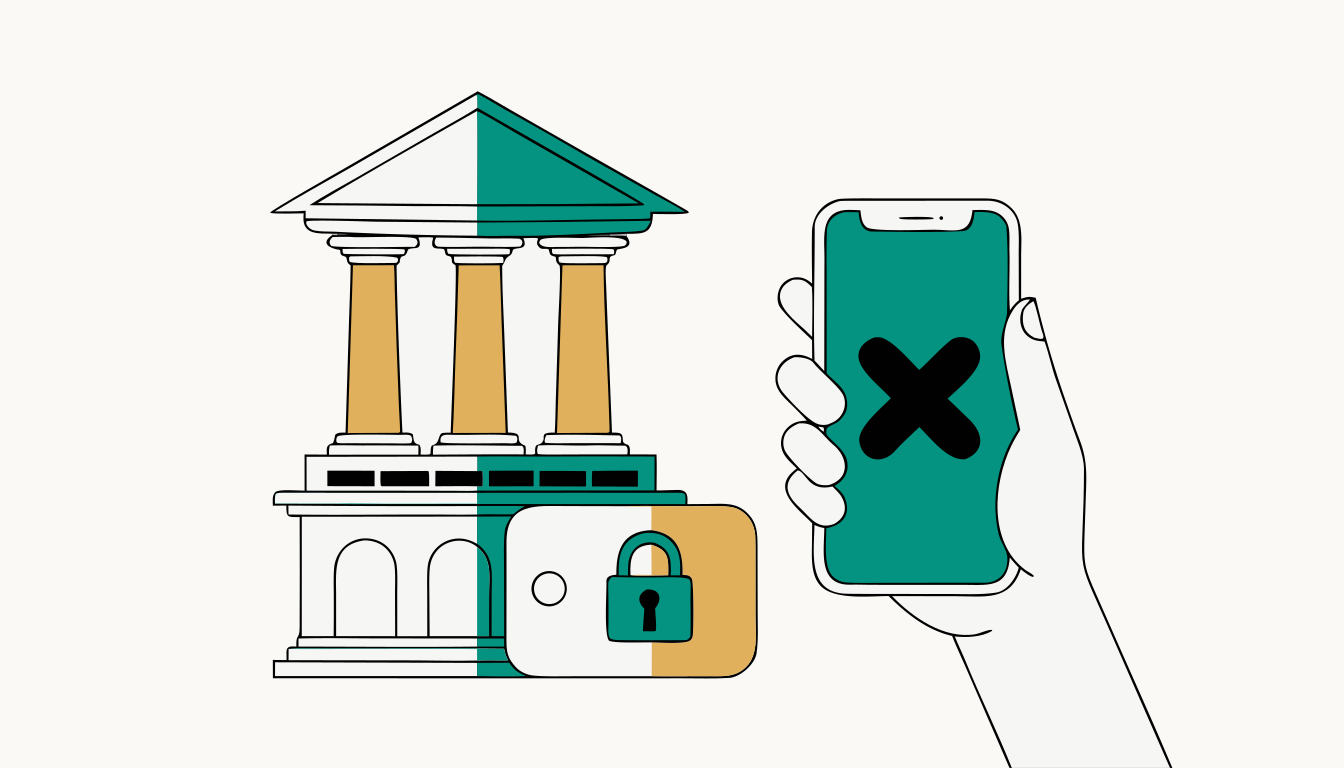
Why the bank declined it
Every card payment carries a merchant category code, and gambling merchants are coded 7995. Your bank does not see a casino name; it sees 7995 from an overseas acquirer and applies whatever rule it has for that code. There are three rules in play.
A gambling block. Most banks below let you block 7995 on a card. Westpac applies it by default to debit cards held by under-18s; Macquarie applies it to every credit card with no switch at all. The decline is instant and the cashier usually shows nothing more useful than “transaction failed”.
Credit-card rules. Since 11 June 2024, section 15C of the Interactive Gambling Act 2001 (inserted by the Interactive Gambling Amendment (Credit and Other Measures) Act 2023) makes it an offence for a licensed Australian wagering service to accept a credit card, a credit-linked wallet or digital currency. It binds the operators, not banks or players, and it does not reach offshore casinos, which the same Act already classes as prohibited services. What reaches them is bank policy: NAB’s credit-card terms say “international gambling transactions from your account are not permitted”; ANZ declines gambling at 85% of a credit limit; ANZ, CommBank, NAB and Westpac all treat gambling on credit as a cash advance, with the fee and interest from day one. New Zealand’s Online Casino Gambling Act 2026 bans credit cards at licensed sites from 1 May 2026.
The casino’s processor. If no 3-D Secure prompt appeared, the refusal came before your bank saw it. Some offshore processors reject AU and NZ cards outright; some code the transaction under a different category so it slips past a block. We cannot tell you which code a casino uses on a given day, and the banks say they cannot either: CommBank warns “some transactions may still go through”, Macquarie cannot see a merchant “categorised under another merchant category code”, and Revolut says the same of companies that “use different MCCs to hide their gambling services”.
What each bank does
Taken from each bank’s own help page or product terms as at September 2026. “Not published” means the bank’s public pages say nothing either way.
Australia
| Bank | Gambling block? | Opt-in or default | Wait to remove | Credit card gambling |
|---|---|---|---|---|
| CommBank | Yes. Lock, Block, Limit in app/NetBank; separate 6-month credit-card block by phone (1800 222 387) | Opt-in | 48 hours (both) | Allowed, charged as a cash advance |
| ANZ | Yes. ANZ App only, “eligible” cards | Opt-in | 48 hours | Declined at 85% of the limit; otherwise a cash advance |
| NAB | Yes. App: Cards, Usage controls, Gambling restrictions; credit and debit | Opt-in | 72 hours | International gambling “not permitted”; anything that slips through is a cash advance |
| Westpac (St.George, Bank of Melbourne, BankSA) | Yes. Online Banking or 132 032; personal credit and debit; blocks “Betting/Casino Gambling” | Opt-in; default on under-18 debit cards | Up to 2 business days | Allowed, treated as “cash in advance” |
| Macquarie | Credit: gambling code blocked permanently, no switch. Debit: not published | Default (credit) | Cannot be removed | Blocked |
| ING | Yes, Visa debit and credit, by phone (133 464) | Opt-in | Not published | Not published |
| Bendigo Bank | Yes. E-banking or app: Cards, toggle the gambling merchant group; or 1300 236 344 | Opt-in | Not published | Not published |
| Up | Not published | — | — | No credit card product |
| Revolut AU | Yes. Profile, Security, Payments, Gambling block; card payments only | Opt-in (“disabled by default”) | Up to 48 hours | Not published |
| Wise | No block. Gambling allowed only where the provider is “licensed in the country in which your account is registered”; otherwise payments returned, account may be closed | — | — | No credit card product |
New Zealand
| Bank | Gambling block? | Opt-in or default | Wait to remove | Credit card gambling |
|---|---|---|---|---|
| ANZ NZ | Yes. goMoney: Cards, Card settings, online gambling toggle; Visa Debit and credit | Opt-in | 48 hours | Not published |
| ASB | No gambling control; Card Control covers online, international, ATM, contactless, limits | — | — | Not published |
| BNZ | No gambling control; app blocks cover online, overseas, ATM, contactless | — | — | Not published |
| Westpac NZ | Yes. Westpac One: Cards, Gambling toggle (since October 2025), debit and credit, includes “overseas gambling merchants”; phone/branch account block since March 2024 | Opt-in | 2 days (toggle); minimum 3 months (account block) | Not published |
| Kiwibank | Yes. Secure message, phone or branch; all Visa Debit and credit cards on your access number | Opt-in | 2 working days (apply and remove) | Not published |
| TSB | Yes. Phone (0800 872 226), app message, web form or branch; Debit and Credit Mastercard | Opt-in | Minimum 6 weeks, then up to 3 working days | Not published |
How to turn a block off
The waiting periods are deliberate and no bank will shorten them, so do this before you plan to deposit, not at the cashier. Where the table says app or online banking, the switch is in the same place you turned it on (CommBank: Lock, Block, Limit; NAB: Usage controls; ANZ: the app only, request removal first and return after 48 hours; Westpac and Westpac NZ: the Cards or Card Services menu; Revolut: Security, Payments). Blocks set by phone or message come off the same way: CommBank’s credit-card block needs a second call after 48 hours, Kiwibank takes two working days, and TSB will not accept the request until the block has been on for six weeks.
Once the period has passed, make one attempt. Repeated retries against a live block look like card testing to a fraud system and can get the card itself locked.
Alternatives that work when the bank blocks
- Debit instead of credit. Both credit bans target credit. A Visa Debit or Debit Mastercard with no gambling lock and international purchases enabled works in every cashier we review, at a 3% international fee from the big four Australian banks. Details on the Visa and Mastercard page.
- Neosurf. A voucher bought for cash carries no card code, so there is nothing for a block to catch. See Neosurf.
- E-wallets. Funding Skrill, Neteller or MiFinity is a payment to the wallet company, not to a 7995 merchant; the gambling leg happens inside the wallet. See e-wallets.
- Crypto via an exchange. Buying Bitcoin or USDT at an AUSTRAC- or FSPR-registered exchange is a transfer to the exchange; the casino deposit is then on-chain and the bank never sees it. Read Bitcoin and the USDT deposit guide.
None of these is a way around a block you set for a reason; they are for the player whose bank refuses 7995 by policy.
Does the bank report you or close your account?
Only two things are verifiable here, so that is all we will say.
What is reported by law. Australian banks file a threshold transaction report to AUSTRAC for physical cash of A$10,000 or more, and an international funds transfer instruction report for electronic transfers “of any value into or out of Australia”, both within 10 business days. A payment to an offshore casino or exchange is reported as a matter of routine, alongside every other cross-border transfer. New Zealand banks file prescribed transaction reports with the Police Financial Intelligence Unit for domestic cash of NZ$10,000 or more and international wire transfers of NZ$1,000 or more. Suspicious matter reports are separate and discretionary; no bank publishes the triggers.
What the banks say about closing accounts. Of the institutions in the tables, only Wise publishes a policy of returning gambling payments and possibly closing the account when the operator is not licensed where you live. The Australian and NZ banks publish no gambling-specific closure policy, only the general right to decline transactions or close accounts that every bank’s terms contain. We have no verified case of an AU or NZ bank closing a personal account solely for casino deposits, and we are not going to invent one.
If you want the block to stay on
A card block is the cheapest tool and the easiest to reverse, which is also its weakness. If you need something that holds:
- BetStop (Australia) is the government self-exclusion register for licensed Australian online and phone wagering providers, from three months to lifetime. It does not cover offshore casinos, because they are not licensed.
- Gamban (paid subscription, seven-day trial) and BetBlocker (free, run by a Scottish charity) block gambling sites and apps at device level; BetBlocker’s restriction cannot be lifted before the period you chose ends.
- TSB’s six-week minimum and Westpac NZ’s three-month account block are the only bank blocks above with a real commitment period; CommBank’s six-month credit-card block still comes off after a 48-hour call-back.
Our responsible gambling page lists the helplines in both countries.
FAQ
Why was my casino deposit declined when I have money in the account? Most often a gambling lock is on, or it is a credit card at a bank that refuses or limits code 7995. Check the card’s controls, check that online and international purchases are enabled, and if you removed a lock recently, wait out the period in the table. A decline with no 3-D Secure prompt came from the casino’s processor.
How do I turn off the CommBank gambling block? In the app or NetBank, open the card, go to Lock, Block, Limit and switch off the gambling lock; it stays in force for 48 hours. The six-month credit-card block comes off only by ringing 1800 222 387, waiting 48 hours, and ringing again.
Will my bank stop me using a debit card at an offshore casino? Not by law. Both the 2024 Australian ban and the NZ Online Casino Gambling Act 2026 target credit at licensed operators. A debit card is declined only if a block is on, the bank restricts international online purchases, or the casino’s processor rejects the card.
This guide is general information about how banks handle gambling transactions, not financial advice. Bank policies change; check the bank’s own help page before relying on any row above.